
Cooler Master V8 ACE 3DHP Black Intel Version Heatsink Review
Author: Dennis Garcia
Benchmarks
The Cooler Master V8 ACE 3DHP is designed for Intel Socket LGA2066 / 2011 / 1700 / 1200 / 1156 / 1155 / 1150 and all modern AMD processors. Keep in mind while the installation and overall design of the V8 ACE is the same there are specific versions for Intel and AMD to better match the processor heatspreaders.
Here is an overview of the system and testing methodology
Z790 Aorus Elite X WiFi 7 – Z790 Chipset
Intel Core i7 12700k (3.2Ghz) Sixteen Core 12+12 32KB L2 Cache 9+9 x 1.25MB L3 Cache 25MB
Coolers
Cooler Master V8 ACE 3DHP
Noctua NH-D15 G2 chromax.black
Cooler Master MasterLiquid Atmos II Stealth
The CPUID System Monitor was used to obtain and record system temperature data and being that this is a quad core processor we need something that will work across all of the cores at once. For this task we're using a new version of Prime95 (p95v255a) that will allow you to spawn (n) instances to test with.
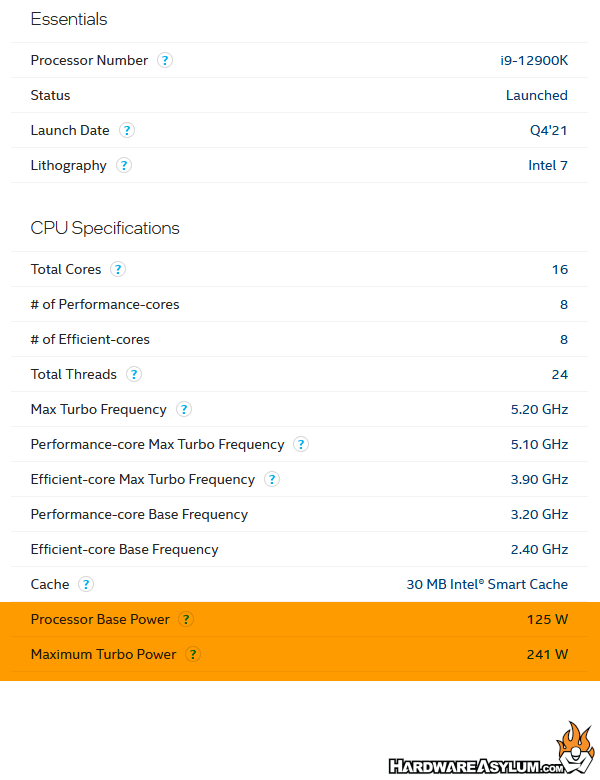
Editors note: Even though the Windows 11 task manager reported 100% processor usage we could never attain a 100% of the rated heat output as documented by Intel when using Prime95 as a basis for that heat production. Knowing this we ran the stress test until the maximum temperature was attainted and stabilized.
Other things to consider when judging software induced heat output.
a) Clock throttling by the processor at high temperatures.
b) Normal software isn't designed to produce maximum heat output.
c) Variances of cooling temperature.
d) Variances in CPU load.
e) Inaccuracies in thermal diode readouts.
Of course the list goes on..
Our testing methodology is aimed to provide a real world look into this heatsink given the test system provided.
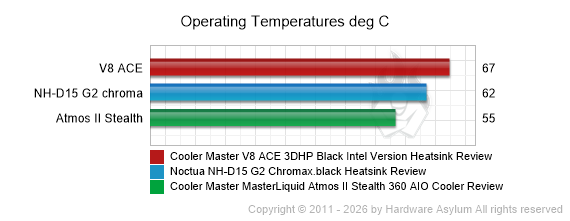
A C/W rating can quickly be calculated using this formula.
C/W = (CPU temp - Ambient temp)/(Variance(%) * CPU Watts)
Allowed variance for this test = 85%
CPU Watts = 125W (or 172W due to turbo clock)
0.26 C/W = (63C - 25C)/(.85(172W))
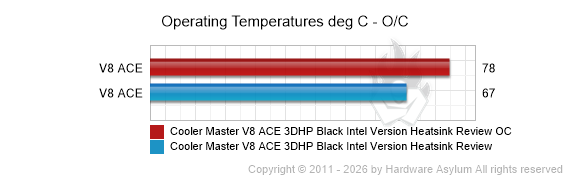
For this next test the CPU speed was cranked up to 4.8Ghz Sync across all performance cores and the test was re-run.
To calculate a new C/W rating for this test we will need to factor in the increased processor wattage. However, given that the overclock is within the range of the max turbo frequency we will simply use the Max Turbo TDP
The variance still applies for our C/W calculation
Allowed variance for this test = 85%
ocC/W = dCPU Watts * (ocMhz / dMhz) * (ocVcore / dVcore)2
ocMhz = 4800
dMhz = 4300
ocVcore = 1.25
dVcore = 1.2
The variance still applies for our C/W calculation
Allowed variance for this test = 85%
CPU Watts = 208W
0.30 C/W = (78C - 25C)/(.85(208W))
In our heatsink and waterblock tests we don't really focus on overall load temperatures but rather how well the product can remove heat given a specified heat load. Since this is a real-world testing method, we need to take into consideration real world variables and estimate tolerances. This is why we normally only apply 85% of the total wattage output to our heat calculations.
The resulting C/W number is used to rate how efficient a heatsink or waterblock is based on the given heat load. These numbers can be used to determine heat capacity, the larger the difference the less efficient the heatsink is. (aka not good for overclocking)
We have an interesting situation here where our Alder Lake CPU is able to quickly saturate the heatsink with only mild overclocking. This is a bit unusual but, completely expected given the design. The calculated TDP of K edition processors is unusually high and puts a strain on even the best watercoolers. With the limited radiator space there is a ceiling to how much heat can be expelled and is right around the 200w TDP mark.
I’m using a performance fan curve in the Gigabyte UEFI that will ramp the fan speed up to match the CPU temperature and activity. That is one reason why the C/W numbers will be closely aligned and usually running 100% under the overclocking loads.
Keep in mind these calculations are provided for demonstration purposes only and may not reflect the actual lab tested C/W rating, but we're pretty close.